Recent advances in geometric foundation models have emerged as a promising alternative for addressing the
challenge of dense reconstruction in monocular visual simultaneous localization and mapping (SLAM).
Although geometric foundation models enable SLAM to leverage variable input views, the previous methods
remain confined to two-view pairs or fixed-length inputs without sufficient deliberation of geometric
context for view selection.
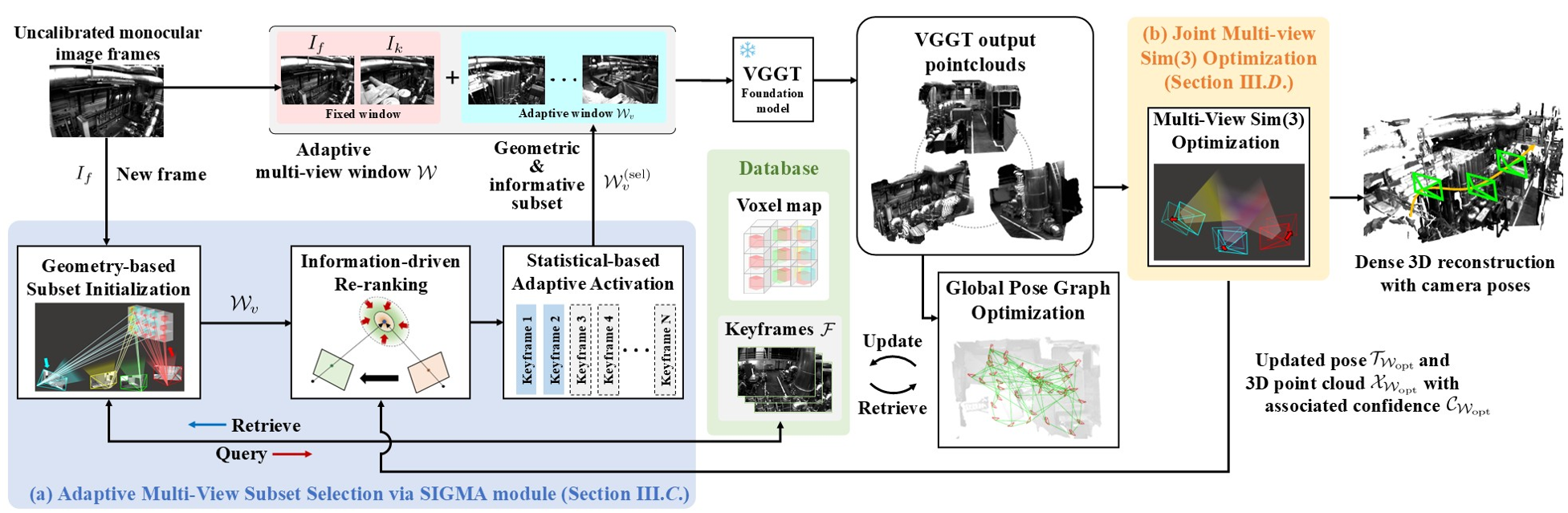
To tackle this problem, we propose AIM-SLAM, a dense monocular SLAM framework that exploits an adaptive
and informative multi-view keyframe prioritization with dense pointmap predictions from
visual geometry grounded transformer (VGGT).
Specifically, we introduce the selective information- and geometric-aware multi-view adaptation (SIGMA)
module,
which employs voxel overlap and information gain to retrieve a candidate set of keyframes and adaptively
determine its size.
Furthermore, we formulate a joint multi-view Sim(3) optimization that enforces consistent alignment across
selected views, substantially improving pose estimation accuracy.
The effectiveness of AIM-SLAM is demonstrated on real-world datasets, where it achieves state-of-the-art
pose estimation performance and accurate dense reconstruction results.
Our system supports ROS integration.